BATHBUDDY
The problem: kids want bubbles; parents don't want motors, batteries and charging cables anywhere near bath water. Powered bubble toys exist, but every one carries the same uncomfortable trade-off — electricity in the wettest room in the house, plus corrosion, dead batteries and short product life.
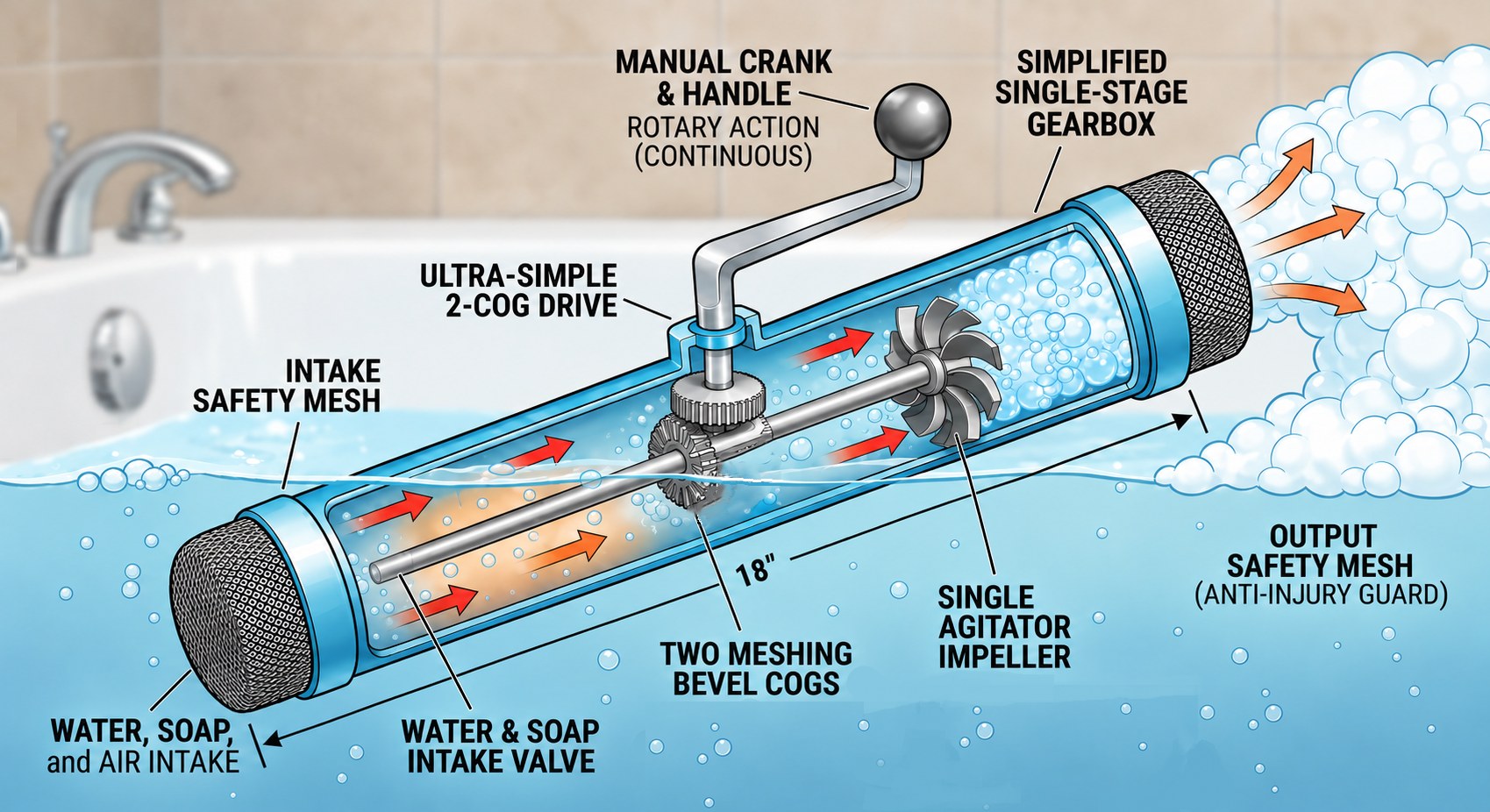
The device: an all-mechanical foam cannon. A single hand crank drives a two-cog 90° bevel set on one continuous shaft, spinning an impeller that draws in bath water and soap solution, whips it into dense foam and fires it out the front nozzle in a continuous stream. No batteries, no motors, no charging — the child provides the power, which is half the fun.
The business case: sits at the intersection of bath toys, water toys and STEM-display products — the transparent shell turns the gearing into the toy's own educational feature. Safety meshes on both intake and output ports answer the first question every parent asks. A mechanical-only BOM keeps tooling simple and margins wide for a toy-and-bathware licensee.
- 100% mechanical — zero electrical components near water
- Two-cog 90° bevel drive on a single continuous shaft
- Unidirectional flow: intake → agitate → foam output
- Dual anti-injury safety meshes on both ports
- Clear cutaway shell — the mechanism is the showpiece
MECHANISM — OVERVIEW
Deliberately minimal: four moving parts do everything.
- Direct-drive crank — one manual handle inserts into the body; no linkages or intermediate shafts
- Two-cog bevel drive — a pair of large coarse-toothed bevel cogs turns crank rotation 90° into the chamber axis
- Single continuous shaft — one unbroken shaft links the gearset directly to the agitator
- Unidirectional impeller — draws soapy water in, whips it to foam, expels it out the nozzle in one flow
- Dual safety meshes — fine guards on both intake and output keep fingers and objects clear of moving parts
Gear ratios, impeller geometry, housing tolerances and materials stack are released under NDA only.
TECHNICAL PACK — NDA GATED
Deeper detail is released under a mutual non-disclosure agreement, issued via the commercial intake gateway.
- Bevel gear specification & ratio rationale
- Impeller blade geometry & foam-yield testing targets
- Intake valve & flow-path detail
- Materials stack, sealing approach & bill of materials
Requests route via products@williamsquantum.com — triaged by the agent core, countersigned by a principal.